
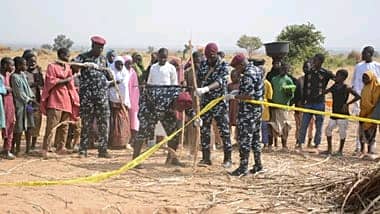

Nigeria police, Anti-Bomb squad, secure the scene of a U.S. airstrike in North-West, Jabo, Nigeria, Friday, Dec. 26, 2025.
Residents of Jabo, a farming village in north-Western Nigeria, were late Thursday gripped by fear after powerful airstrikes lit up the night sky, an attack later confirmed by authorities as a joint US–Nigerian military operation targeting an alleged Islamic State camp.
In Lagos, far from the troubled north, residents, expressed a range of emotions in response to the US’ move to launch strikes against an IS group in North-Western Nigeria.
Some locals were in support of the US president’s actions.
Said Emmanuel Udoh, a reverend, as he paused near a taxi stand: “If another country is coming with the aim of creating stability or peace in Nigeria, why shouldn’t we be in support? I am in support of that”.
Lagos resident Dominic Dioju echoed these sentiments, calling the strike a “welcome development”.
President Donald Trump said on Thursday that the US launched a “powerful and deadly” strike against Islamic State forces, after spending weeks accusing the Nigerian government of failing to rein in the persecution of Christians.
In a Christmas evening post on his social media site, Trump did not provide details or mention the extent of the damage caused by the strikes.
Shuaib Yusuf, another Lagos resident, said he was against the strikes.
Said he while adding that Nigeria could handle this issue itself: “The current issue we have in Nigeria is not a religious crisis. It is a problem of personal kidnapping and bandits, other groups, trying to destroy the country itself”.
Bulama Bukarti, a human rights lawyer and conflict analyst, said the Nigerian government stood to lose support if they could not confirm if these strikes, done with their cooperation, were successful.
He said so far, neither the US nor Nigeria had provided any evidence that they were, with the limited information available showing strikes in two locations, hitting hotels in one and an onion farm in another.
But, he said, most Nigerians would welcome US cooperation if it was successful.
Stated he: “For the ordinary Nigerians, this is a matter of life and death. And any effort that can help towards addressing the insecurity that has been bedeviling Nigeria over the last decade or so, will be welcomed by the overwhelming majority of Nigerians. But that effort has to be intelligence-driven, it has to be precise, and it has to succeed”.
In the directly hit Jabo, a farming village in northwestern Nigeria, a local farmer, Sanusi Madabo, 40, said he was preparing for bed when a loud explosion shook his home and the sky turned bright red. The glow lasted for hours. He added that it felt “almost like daytime”. Many residents initially believed a plane had crashed.
The strike was announced by US President Donald Trump as a “powerful and deadly” attack against what he called ISIS militants in North-Western Nigeria. Nigeria’s government later confirmed the operation, saying it resulted from intelligence sharing and strategic coordination between the two countries.
Vilagers said the airstrikes caused widespread panic, despite no reports of casualties. Jabo has not previously experienced militant attacks, though, neighbouring communities have faced repeated violence. Security forces later sealed off the area, but authorities have yet to release details on the number of targets or any militant casualties.
Yusuf Tuggar, Nigeria’s Foreign Minister, described the strikes as a “new phase of an old conflict”, signaling closer military cooperation with Washington. Analysts said the lack of official information had heightened anxiety among residents.
Some experts believe the strike may have targeted Lakurawa, a little-known armed group operating in the region, though its links to Islamic State remain unclear.
For villagers like Balira Sa’idu, 17, the attack has left deep uncertainty. Said she as preparations for her upcoming wedding were thrown into doubt: “Everything has changed”.


