Nollywood Stakeholders Identify EnablingFactors In Film Industry Innovation, Regulation
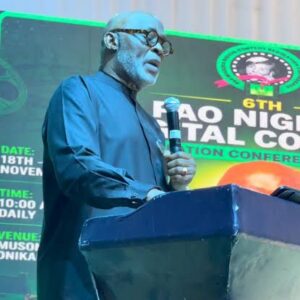
Richard Mofe-Damijo delivers the keynote address at the PAO-NDCRC in Lagos On November 18, 2026. Stakeholders in the Nigerian film industry have identified various factors capable of enabling balanced regulation, intellectual property protection, and investment security to guarantee Nollywood’s sustainability amid the rapid transformation of digital content production and distribution. This came to the fore as they canveged on Lagos for the 6th Peace Anyiam-Osigwe Nigeria Digital Content RegulatoryConference on Wednesday and Thursday. The 6th edition of the conference took a deeper look at the enormous risk involved in the entire process of film-making when an insurance Chief Executive, who spoke at the event, Mrs. Ebelechukwu Nwachukwu, observed that film production, like every business venture, given its own unique feature, comes with its own peculiar risks, such that when such manifests, the consequences could extend well beyond the immediate financial implications. She recommended insurance for the value of the effort, resources and human capital invested in creating something meaningful. For the film industry, she held, insurance could provide protection across different stages of production. Said She: “Insurance is often viewed as something we purchase because we fear something bad might happen. I would like us to look at it differently. “Insurance is not simply about protecting physical assets; it is about protecting the value of the effort, resources and human capital invested in creating something meaningful. “For the film industry, insurance can provide protection across different stages of production. “Like every business venture, film production comes with its own unique set of risks. These may arise from operational activities, the people involved, equipment and infrastructure, production locations, contractual obligations, technology and even the external environment. “When these risks crystallise, the consequences can extend well beyond the immediate financial implications. They can disrupt production schedules, erode investor confidence, affect contractual commitments, compromise expected revenue and, in some instances, threaten the sustainability of an entire production. “As we discuss innovation, regulation and the future of digital content production, we must equally pay attention to how we protect the investments, people and enterprises driving this industry“. She further urged filmmakers and investors to incorporate insurance into production planning to protect their investments from foreseen risks. Nwachukwu, who was represented by the organisation’s Managing-Director, Mr. Sunny Uwagboi, said film production involves substantial investments in resources, including personnel, equipment and locations. These, she said, could be affected by incidents capable of disrupting production and threatening the financial viability of projects. Nwachukwu identified personnel, professional and media liability, equipment, sets, costumes, public liability, motor and transit risks, and certain production-related disruptions as areas where insurance could provide protection, subject to policy terms. She said insurance was not exclusively for large production companies, noting that solutions could be structured to accommodate different production budgets and risk profiles. She urged producers to incorporate risk assessments and insurance costs into their budgets from the outset, while encouraging investors to make adequate risk protection part of their investment considerations. The insurance executive said a resilient film industry could create employment, attract investment, and stimulate economic activities across sectors, including hospitality, transportation, fashion and tourism. Delivering his welcome address, Dr. Shaibu Husseini, Executive-Director and Chief Executive Officer of the National Film and Video Censors Board (NFVCB), said the industry’s future depended on collaboration among regulators, filmmakers, investors, distributors, technology companies and audiences. Husseini said that although artificial intelligence, streaming platforms and digital distribution were creating opportunities for the industry, there were also concerns about Intellectual Property (IP), authorship, ownership, consent and the sustainability of creative businesses. Said he: “Our responsibility is to create an environment where regulation and innovation reinforce one another: protecting creators and audiences while enabling responsible creativity and investment”. He said the Board was pursuing an amendment to its enabling law to remove the word “Censors” from its name and reposition it as a classification-focused regulatory organisation. The NFVCB boss said the proposed reform would support audience empowerment, professionalism and technological responsiveness while providing filmmakers with a clearer framework for responsible creative freedom. Husseini identified piracy, digital distribution and the regulation of content on streaming platforms, social media and video-sharing websites as major challenges facing the industry. He said the NFVCB was strengthening collaboration with relevant institutions, including the Nigerian Communications Commission. Husseini said the Board was also reviewing its classification, exhibition and distribution guidelines to ensure they remained relevant to current industry realities. The Chairman of the Audio-Visual Rights Society of Nigeria, Mahmood Ali-Balogun, emphasised the importance of Intellectual Property protection and royalties to the sustainability of the creative industry. Ali-Balogun said creators needed to benefit financially from their works long after production, noting that rights protection was central to addressing exploitation in the industry. He also acknowledged the NFVCB’s collaboration with the rights organisation, noting that films classified by the board were required for membership registration under an agreement between the two organisations. Representing the family of the late Peace Anyiam-Osigwe, the Chief Executive Officer of the African Movie Academy Awards, Raymond Anyiam-Osigwe, said the conference’s theme was timely, particularly as the industry grappled with the implications of digital technology and artificial intelligence. Anyiam-Osigwe urged content creators and digital practitioners to embrace ethical use of artificial intelligence, noting that their decisions would determine whether the technology became a blessing or a challenge to the industry. Said he: “My view is that, for the players, you have a very important role in terms of ethical use of AI. “That will determine, to my mind, whether the impression is negative or it is a blessing”. He said regulators and industry stakeholders must work together to develop policies that complement the industry’s needs and promote sustainability. He recalled the late Peace Anyiam-Osigwe’s commitment to structure, policy and industry development, saying the family would do its best to sustain her legacy. In presentation of the keynote address for the conference, Richard Mofe-Damijo, Nigerian actor cum filmmaker called for stronger intellectual property protection and better revenue transparency in Nollywood. He spoke on Wednesday opening of the two-day event themed, ‘Film and Content Production in the Digital Era: Balancing Regulation and Innovation’, emphasising that the challenges confronting the creative industry, required that stakeholders must examine the entire content value chain, particularly issues surrounding ownership, distribution rights, royalties and intellectual property. Said he: “We must examine the entire value chain. Who owns the intellectual property? Who controls the distribution rights? How are royalties tracked? What happens when content is licensed across multiple territories? How do you protect the rights of the writers, producers, directors and filmmakers in an environment where digital reproduction has become almost effortless?” RMD as he is popularly known, described these concerns as central to the sustainability of the creative industry, adding that the commercial benefits of Nigerian content’s international appeal must extend to the people responsible for creating it. Observed he: “A creative economy must reward creativity. We cannot continue to celebrate the global popularity of Nigerian content while leaving the creator without sustainable economic returns”. RMD also identified piracy as a major threat to the industry, noting that the unauthorised reproduction and distribution of creative works weaken their commercial value, discourage investment and undermine the livelihoods of creators. He called for stronger collaboration between regulators, law enforcement agencies, digital platforms, rights holders and industry associations to address the problem. Stated he: “We cannot continue to celebrate the global popularity of Nigerian content while leaving the creator without sustainable economic returns. Digital distribution has expanded the market but it has also introduced new complexities around ownership, license, revenue transparency and intellectual property protection. “Piracy still remains a serious threat, the unrecognised reproduction and distribution of creative works, weaken the commercial value of content, discourage investment and undermine the livelihoods of the people who make it. ...